

Driving home from Second Chance Farm in Milan, I am struck by the lesson various farms offer as I take my tour of our farm community. Each small-scale farm offers a different reflection of the same sentiment: the deep desire to stay connected to the land and provide quality food for the surrounding neighborhood. This desire surpasses the inevitable struggles of farming—the weather, the pests, the lack of economic fortune. In their own way, each farmer aims to build connections to the animals and fields they care for, to the people they feed, and to the food they eat.
Second Chance farmers Charlie and Kim Godfrey take great pride in their farm. Keeping a clean and tight operation is an imperative for Charlie. They want “to make a good first impression,” Charlie says, because “we work so hard to make a good product.”
Seven years ago, Second Chance started out with Kim’s horse. Instead of paying a stable to house and care for her, they thought they would have the land and facilities to do so themselves. With the addition of a handful of mini driving horses, and a Belgian Draft for Charlie to ride, the farm family grew.
As Charlie so simply put it: Then we said… let’s raise a pig,” So they started raising pigs.
“We’re both first-generation farmers,” Kim says joyfully, a smile on her face.
Although farming is a second career for both Kim and Charlie—Kim still works full-time as a nurse and Charlie recently retired from the Poughkeepsie police force—the name Second Chance does not refer to their second career. “Second Chance was us,” Charlie says emphatically: Charlie and Kim dated 30 years ago, and then met again in 2003. Their relationship finally had a chance to bloom and grow, birthing Second Chance Farm a few years later when they began building it together—creating the infrastructure of high-tinsel electric fencing, running water and electric lines, clearing overgrown and unmanaged fields.
From that first pig, the farm now has pastured broiler chickens, grass-fed and grain-finished beef, and heritage pigs. The white Cornish-cross chickens are raised in batches of 50, housed on grass, and slaughtered on the farm in the company of friends and neighbors before being sold fresh or frozen.
Since the farm does not have enough land to support beef cows on-site, the cattle are raised on grass in Stanfordville and then brought back to the farm for about four months where they are sustained on a diet of grain and hay to “finish” the animal and create marbling in the meat.
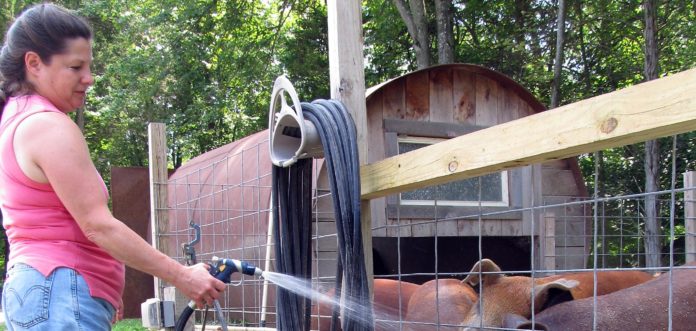
The two herds of Tamworth-cross pigs — a breed known in meat circles as “the bacon pig” because of their long bellies — are housed on clean concrete pads where the pens can be hosed down and washed every day to keep the animals clean and healthy.
Although they do not feed organic grain, Kim and Charlie focus on trying to keep their meat affordable, and emphasize supporting local farmers by buying grain from Bruno Feeds in Hudson—where the feed is ground, mixed, and always fresh.
Reflecting on the financial aspect of farming, Charlie remarks, “You’ll never get rich doing this, but it’s still fun… we make enough to stay alive, and as busy as you are, it’s not the humdrum of going to work.” Kim brings it back to the food, from which the whole farm evolved: “We eat well,” she says; with a vegetable CSA share to supplement, the bulk of their diet comes from “a 10-mile radius of where I stand.”
You can buy from Second Chance at the Winter Sun winter farmer’s market through Vassar College, or find them on Facebook. But Charlie and Kim love to welcome folks to the farm; Charlie feels that “farms are the greatest thing in the world for kids.” They invite families and children to experience the farm firsthand. To schedule a visit to the farm, you can contact Charlie and Kim at 845-876-7702 or chas273@yahoo.com.
Charlie and Kim envision continuing to farm for a long time: when Kim periodically asks Charlie, “How much longer do you think we can do this?” he answers simply, “Until we can’t.”




Facebook Comments